Shipping to Canada only. For shipping to the United States, click here
No products in the cart.
Waterjet
Parts
Garnet
Abrasives
Laser Welding
Consumable
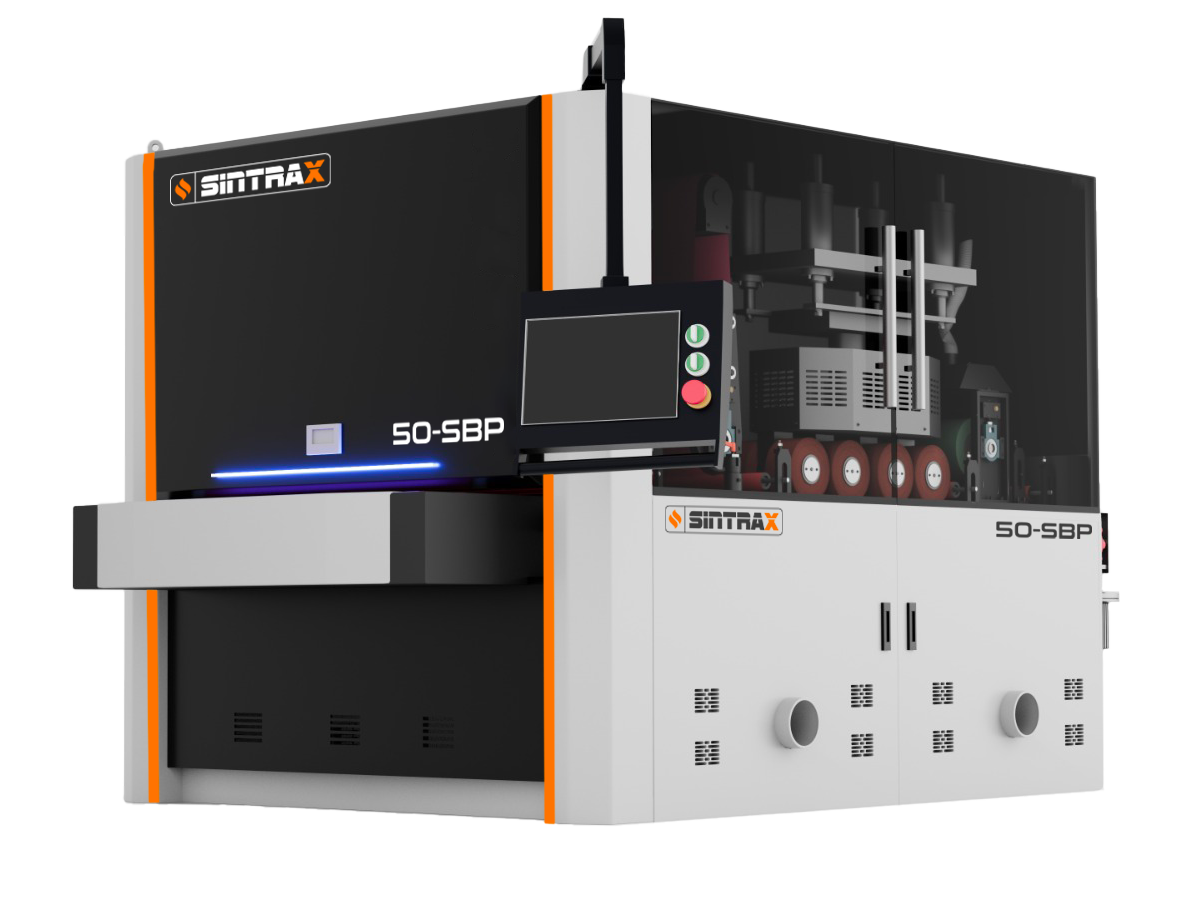
In metalworking, deburring is the process of removing sharp edges and burrs left behind during manufacturing. Rotary brush deburring machines are designed to efficiently smooth and finish part surfaces.
The SINTRAX Deburring Machine is ideal for integration with laser cutting machines, CNC stamping systems, and other machining lines. Using a linear feed process, it employs multiple rotating abrasive brushes that alternate in direction and motion, ensuring uniform burr removal from flat surfaces, contours, and hole edges. It also enables precise and even chamfering across all processed parts.
This solution delivers high-quality, defect-free surfaces that are smooth, ready for coating or welding, and give parts a professional appearance. Enhanced safety is achieved through fewer sharp edges, reduced manual handling, and greater operator protection, while consistent, repeatable results ensure compliance with customer specifications.
The machine saves valuable time by accelerating processes, reducing manual corrections, and shortening production cycles, while its versatility allows efficient processing of steel, aluminum, and various thicknesses. Designed for high productivity, it achieves fast processing speeds, manages large batches with ease, and minimizes manual intervention. Ultimately, it helps reduce costs through lower labor requirements, less rework, and overall production savings.
Are deburring machines profitable?
Yes. Automated deburring eliminates the finishing bottleneck that slows down most laser and plasma cutting operations. Labor costs drop, reject rates fall, and throughput increases. For fabrication shops with significant manual finishing time, the investment pays for itself. Most SINTRAX customers reach ROI within 12 to 24 months.
What is the ROI of an automated deburring machine?
It depends on three variables: current labor cost for finishing, production volume, and reject rate. A shop where one operator spends a full day hand-filing a part with 1,000 holes can reduce that to 15 minutes with automated deburring. That single gain, applied across a week of production, covers a significant share of the machine cost. Savings also come from fewer rejected parts and less rework sent back from painting or welding.
Why automate instead of manual grinding?
Manual deburring produces results that vary by operator, by time of day, and by fatigue level. The same part finished by two different operators will not look the same. Automated deburring removes that variable: every part goes through the same process at the same settings and comes out with the same edge quality. It also removes operators from grinding hazards, sharp edges, vibration, and metallic dust exposure.
How does a rotary brush deburring machine work?
A rotary brush deburring machine feeds flat metal parts through a conveyor system, passing them under multiple rotating abrasive brush heads. The brushes alternate direction and motion, which is what allows them to reach all edge orientations, including internal contours and hole edges, in a single pass. A multiheads system combines several independent processing stations: typically an abrasive belt for surface treatment, rotary brushes for edge rounding, and an optional polishing module. Each station works simultaneously, so the part comes out fully finished without multiple handling steps or separate machines.
What is the difference between wet and dry deburring?
Dry machines handle carbon steel and stainless steel in most standard shop environments. Wet machines use water or coolant to capture fine metallic particles, which matters when processing aluminum or titanium: fine dust from these materials can become combustible under certain concentrations. If your shop processes aluminum in volume, the dust collection configuration is a safety specification, not just a cleanliness preference.
What materials can SINTRAX deburring machines process?
Most flat-sheet deburring machines handle carbon steel, stainless steel, and aluminum. The configuration changes based on the material: abrasive grain selection, brush type, and dust collection requirements all vary. Part geometry also matters. Flat parts with simple profiles behave differently from parts with many holes, countersunk features, or complex internal contours. The right machine setup depends on what you actually run, not just the material listed on the spec sheet.
Can a deburring machine also round edges?
Yes. Edge rounding is a separate function from burr removal, and both can happen in the same pass on a properly configured machine. Rounding replaces a sharp 90° edge with a controlled radius. This matters for three reasons: operator safety during handling, coating adhesion (paint and powder coat bond better to a rounded edge than a sharp one), and compliance with customer specs that require a specific edge break. The key is controlled, repeatable pressure, not aggressive removal.
What type of machine do I need: belt, brush, or tumbler?
For flat sheet metal parts coming off a laser cutter, plasma cutter, or waterjet, belt and brush machines are the right category. They handle the part continuously, process surface and edges in the same pass, and scale to production volume. Tumbling works for small parts processed in batches, but it does not give you control over individual part geometry or edge consistency. If your shop runs flat parts in any significant volume, a belt or brush machine is the correct answer.
What quality problems are caused by burrs?
Several, and they compound downstream. Burrs prevent parts from sitting flat in assembly fixtures. They create stress concentration points that can initiate cracks. They cause coating failures at edges, where paint or powder coat is thinnest. Laser and plasma cutting also leave a heat-affected zone with surface oxides that compromise weld quality and coating adhesion if not removed. Every step downstream of an unfinished part carries extra risk of rework or rejection.
How do I avoid over-deburring parts?
The answer is process control, not operator judgment. A high precision deburring solution controls brush pressure, belt speed, and conveyor speed digitally, with parameters saved per job. You run the first part, validate the result, save the settings, and every subsequent part comes out the same. Over-deburring happens when settings are not controlled or when operators adjust manually between parts. A repeatable automated process eliminates both risks.
Why choose SINTRAX?
SINTRAX deburring machines are built for Canadian fabrication shops, certified to Canadian electrical standards, and supported locally by Spark & Co in Quebec and Ontario. When a European premium machine is priced out of reach and a no-name imported machine comes with no support structure, SINTRAX positions between the two: proven performance, local parts stock, and a team you can reach in hours. The interface is bilingual French/English. One Ontario fabricator serving defense and transport clients reduced a 1,000-hole part from a full day of manual filing to 15 minutes, with reject rates on countersunk holes going from 20-30% to zero.
SINTRAX Sanding Machine is primarily designed for surface preparation and aesthetic enhancement rather than edge finishing or burr removal. It delivers consistent finishes on metal sheets, making it an essential tool in industries where appearance and coating quality are critical.
Typical applications include surface graining and brushing, which create uniform finishes such as the #4 satin look commonly required for stainless steel or aluminum panels used in elevators, commercial kitchens, architectural façades, signage, and decorative components.
SINTRAX Sanding Machine is also effective for removing oxide layers or heat tints left by laser or plasma cutting, restoring a clean and uniform metal appearance.
Additionally, it is useful for descaling and eliminating light surface rust, preparing mild steel sheets for coating or painting, and smoothing out stored or exposed parts. By creating a consistent anchor profile, this machine improves adhesion for powder coating, adhesives, and laminates, ensuring both durability and professional results.
![]() | ![]() | ![]() | ![]() | ![]() |
|
|---|---|---|---|---|---|
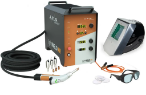
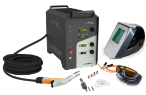
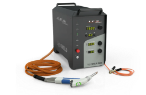
| LightWELD 2000XR Welding & Cleaning | LightWELD 1500XR Extended Range Welding & Cleaning | LightWELD 1500XC Welding & Cleaning | LightWELD 1500 Welding | LightWELD 1000 Welding |
|
| Welding Capability: Steels | Stainless, Galvanized & Mild Steel: up to 8 mm (0.315” ) | Staineless Steel, Mild Steel, Galvanized Steel 6.35 mm (0.250'') | Staineless Steel, Mild Steel, Galvanized Steel 4 mm (0.160'') | Staineless Steel, Mild Steel, Galvanized Steel 4 mm (0.160'') | Staineless Steel, Mild Steel, Galvanized Steel 4 mm (0.160'') |
| Welding Capability: Aluminium | Aluminum 3 & 5 Series: up to 8 mm (0.315”) Aluminum 6 Series: up to 5 mm (0.200”) | Aluminium (3XXX, 5XXX, 6XXXseries) 6.35 mm (0.250'') | Aluminium (3XXX, 5XXX series) 4 mm (0.160'') | Aluminium (3XXX, 5XXX series) 4 mm (0.160'') | Aluminium (3XXX, 5XXX series) 4 mm (0.160'') |
| Welding Capability: Titanium and Nickel Alloys | Titanium & Nickel Alloys: up to 7 mm (0.275” ) | Titanium and Nickel Alloys 6.35 mm (0.250'') | - | - | - |
| Welding Capability-Cooper | Copper: up to 3 mm (0.120”) | Copper 2 mm (0.080'') | - | - | - |
| Wooble Welding | Up to 5 mm width | Up to 5 mm width | Up to 5 mm width | Up to 5 mm width | Up to 5 mm width |
| Cleaning Capability | Pre- & Post-weld up to 15 mm width | Pre- & Post-weld up to 15 mm | Pre- & Post-weld up to 15 mm | - | - |
| High Frequency Peak Power for Cleaning | 3000 W | 2500 W | 2500 W | - | - |
| Wire Welding Capability | Yes | Yes | Yes | Yes | Yes |
![]() | ![]() | ![]() | ![]() | ![]() |
|
|---|---|---|---|---|---|
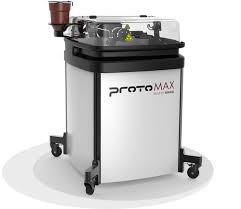
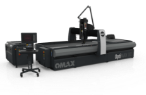
| OPTIMAX | OMAX | MAXIEM | GLOBALMAX | PROTOMAX | |
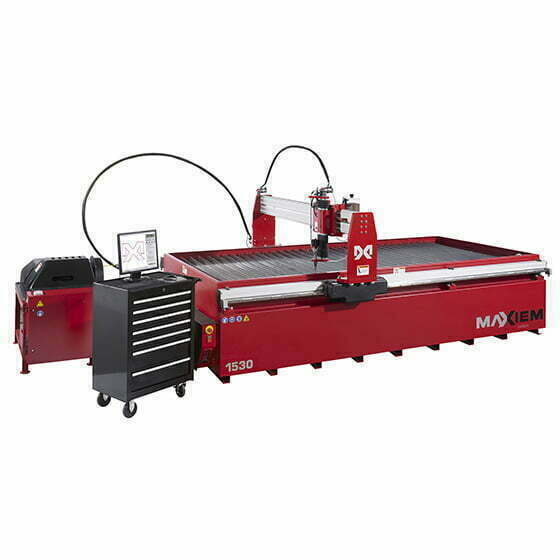
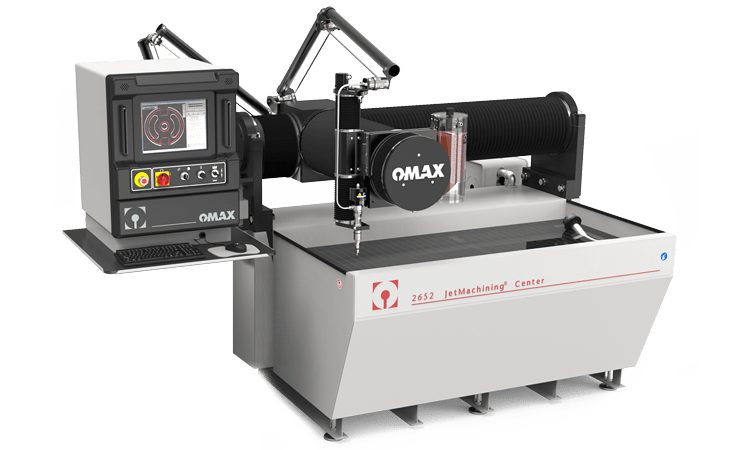
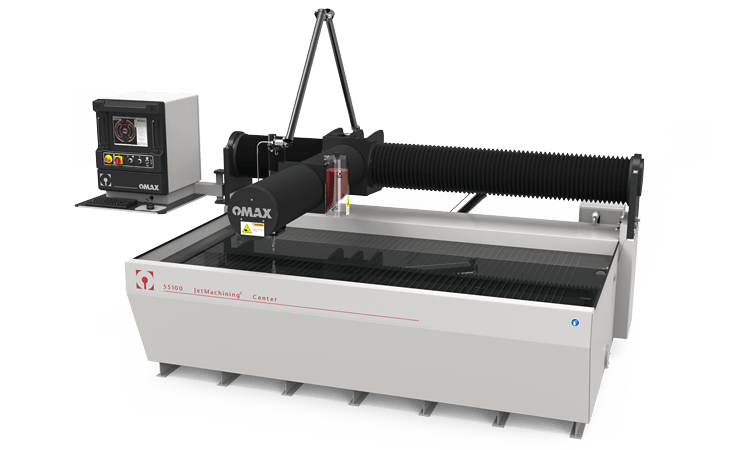
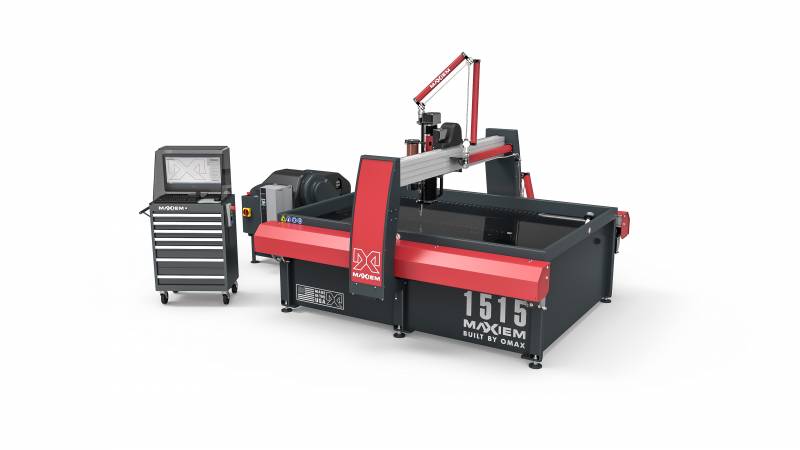
| Product Description | The complete waterjet machine utilizing the best OMAX has to offer. | The workhorse of waterjets, the OMAX line offers precision, performance, and power. | Maximum capability with the widest accessory compatibility. | Configured for your business with broad accessory compatibility. | Value abrasive waterjet with essential accessory compatibility. |
| 3-Axis | Programmable Z | Programmable Z | Programmable Z | Programmable Z | Manual Z |
| 5-Axis | VersaJET, TiltaJET | A-Jet, TiltaJET | A-Jet | ||
| 6-Axis | Coming Soon | Rotary Axis with A-Jet/TiltaJET | |||
| Cutting Nozzle | MAXJet 5i | MAXJet 5i | MAXJet 5i | GlobalMAX Nozzle | ProtoMAX Nozzle |
| Cutting Bed Sizes | 10'0" x 5'2" to 13'4 x 6'8" 3.04 m x 1.57 m to 4.06 m x 2.03 m | 2'5" x 2'2" to 46'8" x 13'4" 0.73 m x 0.66 m to 14.2 m x 4.0 m | 5’2” x 5’2” to 20'6" x 10'2" 0.79 m x 0.77 m to 6.2 m x 3.1 m | 2'7" x 5'0" to 13'3" x 6'8" 0.80 m x 1.5 m to 4.0 m x 2.0 m | 12" x 12" 0.3 m x 0.3 m |
| Cutting Bed Weight Capacity | 400 lbs/sq ft 1950 kg/m2 | 400 lbs/sq ft 1950 kg/m2 | 300 lbs/sq ft 1465 kg/m2 | 100 lbs/sq ft 488 kg/m2 | 50 lbs/ sq ft 244 kg/m2 |
| Ballbar Circularity | ±0.003" ±0.076 mm | ±0.0025" to ±0.005" ±0.064 mm | ±0.005" ±0.127 mm | ±0.007" ±0.178 mm | ±0.016" ±0.406 mm |